We’re not against it, but there is some philosophy to resolve.
First, the fact that it’s disconnected from the rest of the app is possibly as much of a bug as it’s a feature. Anything you write in a description of a character doesn’t become actionable in the app. Instead, the intention was that you’d actually make notes and beats in the character folder. The upside of especially beats is that once you write what the character does, these are actually events that can now be used in the script.
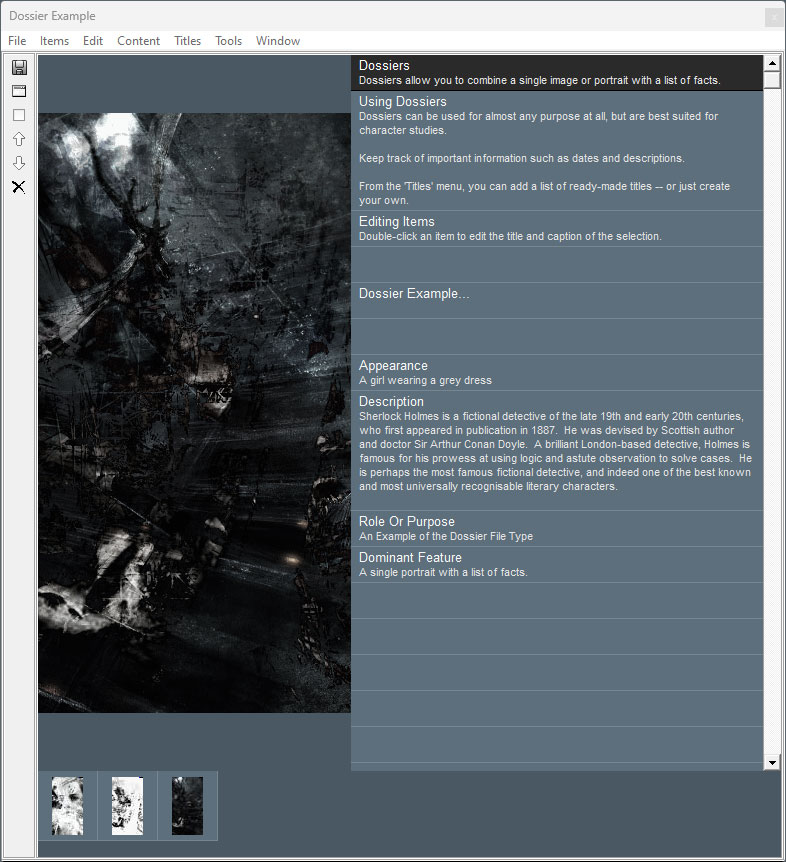
In the example from your screenshot, you have a “Role Or Purpose”. That could be a folder under the character. Under that you make a folder called “To Get The Girl”, and under that, you could already be writing beats that are about getting the girl. This has an important benefit, that it takes your ideas out of the abstract. In Liquid Story Binder, you might write “he behaves awkwardly around her”, but that’s actually not very concrete. Writing beats forces you to immediately consider exactly what the character does, and how the abstract ideas are converted into concrete action.
So the way Causality currently expects you to do it pushes you in a “correct” direction or “show, don’t tell”. Liquid Story Binder (or any text field setup) pushes you in the direction of “tell, don’t show”.
Secondly, such a list of organized fields bring the baggage of a specific system, of story development, and Causality is fanatically agnostic about which exact system of story development you’re using. Having a “Role or Purpose” is fine in one system. But another system might be more interested in the character’s “Original Trauma”, or his “Jungian Shadow” or whatever. How do we choose which fields to include, without forcing a system on every user? Everyone feels that they system they already use is “standard”, but side by side, they’re irreconcilable.
This means that the only way to do a field system is to make it custom, with presets, so that you can load up Save The Cat or The Hero’s Journey or whatever. The problem is that it’s still a duct-tape feature, because it only lives in a small part of the app, and even so is still disconnected from the app. Nothing you write here can actually be used in the app. It’s just a place to brainstorm, and then eventually you’ll create beats where you re-do the work.
In our view, the most satisfying solution would be folder templates. It would load up a pre-baked structure for a character along with subfolders, beats, and notes, that specific questions you have to answer, and beats you have to write.
One folder template could include beats you have to populate (an Inciting Incident, a Crisis), or a note where you write about the character’s original trauma along with three beats where you have write three ways this can be physically expressed in the story.
In my view, this is the best of both worlds. (A) it forces you to answer specific questions for all characters and the story as a whole according to a certain writing system, (B) everything is directly usable in the story when you’re ready, and (C) it specifically forces you to get away from abstract descriptions, and to write specific actions into beats.
We’re very slow to make these kinds of changes, because we only get one chance. If we make the wrong thing, people will start using it, and it becomes near impossible to build the right thing afterwards.
I think the above is still the best bet. It could also be thought of a broader feature as simply being able to export a folder from research and import it elsewhere. Many people have found themselves implementing the same folder structure for each character. With this as basically just an import/export/template feature, you can set up one character perfectly with all the questions you want answered, and then re-do that for every character. And then the community could make templates for different writing systems and we could ship them with the app.


 PLS always make AI being just optional. Please!
 What I do is plotting the very beginning in Dramaqueen and pushing it into Causality (like copying it). I do describe the PlotPoints, Twists in a single TAG-lane é voila - there you go, it’s set up.