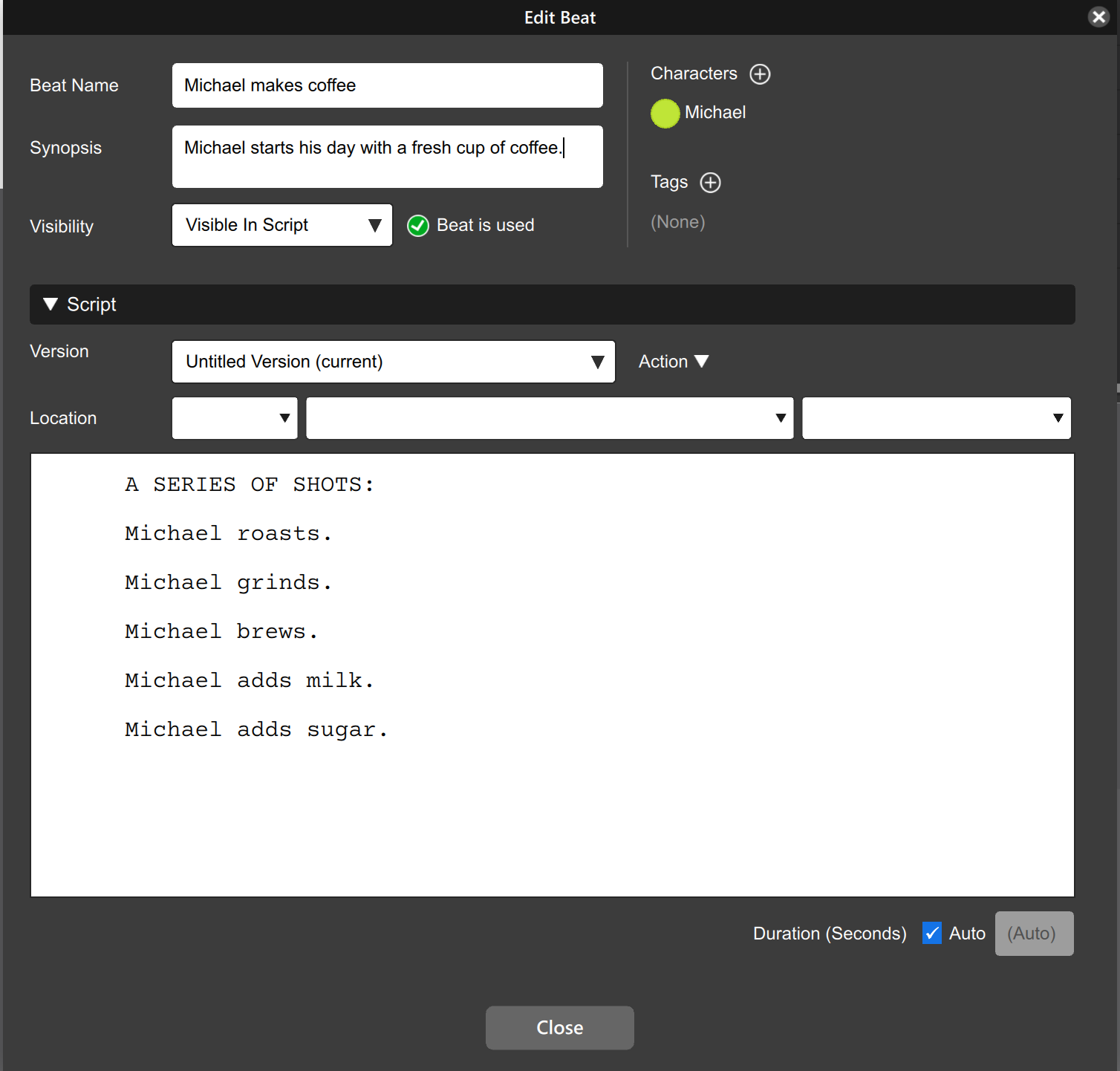
Typically “A SERIES OF SHOTS” is used to signal that what follows is a list of specific list of shots, emphasis on the actual shots. For example:
A SERIES OF SHOTS:
- Footprints leading into the forest.
- Sunbeams piercing the canopy.
- A bead of sweat rolling down Michael’s neck.
- Michael's free hand fidgets with a carabiner.
This construction is often used (mistakenly in my opinion) to create a montage or mini-montage whose purpose is to build up a particular impression (“Michael working out,” “Michael studying,” even “Michael aging.”). There are many ways to format a montage, but a typical case is:
MONTAGE BEGINS:
Bruised and bandaged POLICEMEN in riot gear sit on the curb
slurping instant noodles.
On a department store rooftop, CHILDREN enjoy a live
performance——a masked hero battling villainous creatures.
Lights flicker on inside hundreds of concrete pods stacked on
top of each other, a stark structure against the evening sky.
Cars on an elevated highway streak through a labyrinth of
skyscrapers.
<More beats…>
MONTAGE ENDS.
The “beats” in the montage are like mini-scenes, rather than shots. And though there is overlap between usages, I would say that A SERIES OF SHOTS is best used for short runs of very specific images, while a montage is a little more expansive, perhaps a bit less specific in terms of actual images, and meant to gradually build up or reinforce a particular impression.
How best to follow your character from A to B depends on the length and complexity of their journey and on how important each particular stage of the journey is. If you are trying to show “Michael crossing Manhattan” you could do this using with a series of actual scenes (each with a scene heading) of Michael stepping onto a subway, hailing a cab, crossing a busy intersection, etc. Using actual scenes makes it easier to integrate dialogue, for example, or more complex descriptions. A SERIES OF SHOTS and montage-style constructions really work best if the beats are wordless and limited to shorter descriptions (less than a line each for SERIES OF SHOTS and just a short paragraph for MONTAGE).
A SERIES OF SHOTS and montage-style constructions have their uses, but they are often used as a shortcut, a stand-in for something more complex, or a way to reduce screenplay page length. Don’t do that.
Remember, there is nothing wrong with using actual scenes, even super short scenes, wordless scenes, or scenes that imply just one image. So try writing it as a series of actual scenes before switching to A SERIES OF SHOTS or a montage-style construction.
(my opinion)